

How to Identify Business Opportunities: A Strategic Guide for Entrepreneurs

How to Identify Business Opportunities: A Strategic Guide for Entrepreneurs
Introduction
Identifying business opportunities requires systematic market analysis to find gaps where customer demand exceeds current supply. This proven approach reduces startup failure rates by validating market needs before investment.
What This Guide Covers
Five core identification methods, practical evaluation frameworks, and validation techniques to separate viable opportunities from unproven business ideas.
Who This Is For
This guide serves aspiring entrepreneurs, small business owners seeking growth, and professionals exploring new revenue streams. Whether you’re launching your first venture or expanding existing businesses, these methods apply to any market analysis.
Why This Matters
Thorough market research prevents costly mistakes. Most failed startups pursued opportunities without validating customer needs or understanding competitive dynamics.
What You’ll Learn:
Market gap identification through customer pain point analysis
Trend monitoring techniques for emerging market opportunities
Competitive analysis methods to find underserved segments
Step-by-step validation framework for opportunity evaluation
Understanding Business Opportunities
A business opportunity exists when market demand for a product or service exceeds available supply, creating potential for profitable entry.
Successful opportunities combine three elements: genuine customer needs, market accessibility, and alignment with your core competencies.
Market Gap Opportunities
These represent completely unmet customer needs in existing markets. Success lies in discovering what potential customers want but cannot currently obtain.
Disruption Opportunities
Lower-cost alternatives targeting price-sensitive segments or simplified solutions for new customer groups. Building on gap analysis, disruption opportunities often emerge from technological advancements that enable different approaches to solving business problems.

Five Methods to Identify Opportunities
Systematic opportunity identification combines multiple research approaches to uncover viable market gaps.
Customer Pain Point Analysis
Document frustrations in daily business operations and consumer behavior. Interview potential customers about their biggest challenges and current workarounds.
Focus on recurring complaints about existing products or services. One example: expensive, time-consuming processes that manual solutions could streamline.
Market Trend Monitoring
Track demographic shifts, technological advancements, and regulatory changes creating new market opportunities.
Monitor industry reports, government data, and social media platforms for emerging patterns. Keep track of innovation announcements and policy updates affecting your target market.
Competitive Gap Analysis
Map competitor offerings against customer segments to identify underserved markets.
Analyze competitor pricing, features, and customer feedback. Look for niche markets where existing businesses focus only on large enterprises, leaving small businesses underserved.
Technology-Driven Opportunities
New technology often enables solutions to previously unsolvable problems or dramatically reduces costs for existing solutions.
Monitor patent filings, research publications, and startup funding announcements for emerging capabilities.
Regulatory Environment Changes
Policy shifts create new requirements or remove barriers, generating fresh opportunities for new entrants.
Key Points:
Multiple identification methods increase success probability
Customer interviews provide direct market validation
Technology and regulation changes signal emerging markets
Competitive gaps reveal immediate entry opportunities

Step-by-Step Opportunity Evaluation Framework
Systematic evaluation prevents pursuing attractive-sounding ideas without market foundation.
Step-by-Step: Market Validation Process
When to use this: After identifying potential opportunities through any method above.
Define Target Customer Profile: Create specific demographics, company size, and pain point descriptions for potential customers
Conduct Customer Interviews: Interview 20+ potential buyers about their current solutions, frustrations, and willingness to pay
Analyze Competitive Landscape: Map direct and indirect competitors, pricing models, and market positioning
Calculate Market Size: Use bottom-up analysis based on interview data rather than top-down industry estimates
Comparison: High-Potential vs Low-Potential Opportunities
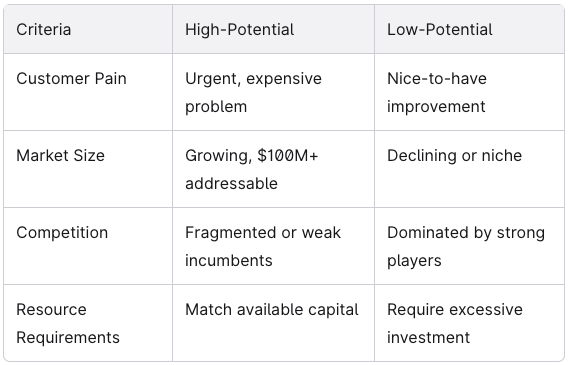
Prioritize opportunities where customers actively seek solutions and demonstrate willingness to pay premium prices for better alternatives.

Common Challenges and Solutions
Most entrepreneurs encounter predictable obstacles during opportunity identification.
Challenge 1: Confirmation Bias
Solution: Structure customer interviews with open-ended questions. Actively seek contradictory evidence about market demand assumptions.
Challenge 2: Market Size Overestimation
Solution: Apply conservative bottom-up market sizing using actual customer interview data rather than industry projections. Focus groups provide deeper understanding of realistic adoption rates.
Challenge 3: Timing Misjudgment
Solution: Monitor early adopter behavior and technology adoption curves. Assess whether target audience demonstrates readiness for behavior change required by your solution.
Conclusion and Next Steps
Systematic opportunity identification combines customer research, competitive analysis, and trend monitoring to reduce entrepreneurship risks. Success requires continuous learning and market validation before significant investment.
To get started:
Choose one identification method and spend two weeks gathering data
Conduct 10+ customer interviews about identified opportunities
Apply validation framework to evaluate findings objectively
Related Topics: Business plan development, market entry strategies, competitive advantage analysis, and business model design for new market opportunities.