

How to Validate a Business Idea: A Complete Guide for Entrepreneurs

Introduction
Business idea validation is the structured process of testing whether your startup idea has real market demand before investing significant time and money. This systematic approach replaces guesswork with evidence-based decisions, helping entrepreneurs avoid the 90% startup failure rate often caused by building products nobody wants.
What This Guide Covers
This guide covers essential validation methods, customer research techniques, and a proven 5-stage framework for testing any business or product ideas before launch.
Who This Is For
This guide is designed for aspiring entrepreneurs, startup founders, and business owners looking to test new business concepts. Whether you’re validating your first startup idea or exploring new business ideas within an existing company, you’ll find actionable validation steps.
Why This Matters
Proper idea validation prevents wasted resources and identifies real market opportunities. Most failed startups skip validation, building solutions without confirming customer demand or understanding their target market.
What You’ll Learn:
Core validation methods and testing frameworks
Customer research techniques for gathering real feedback
Step-by-step validation process
How to analyze results and make data-driven decisions
Understanding Business Idea Validation
Business idea validation is the systematic testing of assumptions about your product or service before full development. It examines three critical dimensions: whether customers want it (desirability), whether you can build it (feasibility), and whether it can become profitable (viability).
Validation prevents entrepreneurs from waste time building products without market demand. Instead of hoping customers will appear, validation provides valuable insights about real customers and their pain points before major investment.
Market Validation vs Product Validation
Market validation tests whether sufficient demand exists for your solution within your target market. This involves assessing market size, competition analysis, and understanding customer needs through research and customer interviews.
Validation Timing and Scope
Validation should begin immediately after forming your initial idea, before creating detailed business plans or product development. This early validation process helps identify core problems, target audience needs, and potential customers while concepts remain flexible.
Essential Validation Methods
Building on validation fundamentals, these practical approaches help test your startup idea systematically.
Customer Discovery Interviews
Customer validation interviews involve structured conversations with potential customers to understand their pain points, current solutions, and willingness to pay. These interviews provide real feedback about whether your value proposition resonates with your ideal customer.
Market Size and Competition Analysis
Market research examines your target market size, growth trends, and existing solutions. Unlike customer interviews, market analysis provides quantitative data about demand patterns, pricing expectations, and competitive landscape to assess market size objectively.
MVP Testing and Feedback
A minimum viable product (MVP) or landing page allows you to test your solution with real users. This method validates product-market fit by measuring actual behavior rather than stated intentions.
Key Points:
Focus on learning, not proving you’re right
Test riskiest assumptions first
Gather feedback from paying customers when possible

Step-by-Step Validation Framework
This systematic approach builds on previous validation methods to create a comprehensive testing process.
Step-by-Step: The 5-Stage Validation Process
When to use this: Apply this framework when validating any new business idea from initial concept.
Define assumptions and hypotheses: Write down key assumptions about your target audience, their core problem, your unique value proposition, and business model components.
Assess market size and demand: Research search volume, industry reports, and competitor analysis to validate sufficient market opportunity exists.
Conduct customer interviews: Interview 10-15 potential customers using an interview script focused on understanding their current solutions and pain points in their own words.
Build and test MVP: Create a simple version or landing page to measure real interest and obtain feedback from possible customers.
Analyze results and iterate: Review feedback patterns, test metrics, and customer insights to decide whether to pivot, iterate, or move forward.
Comparison: Lean Startup vs Traditional Validation
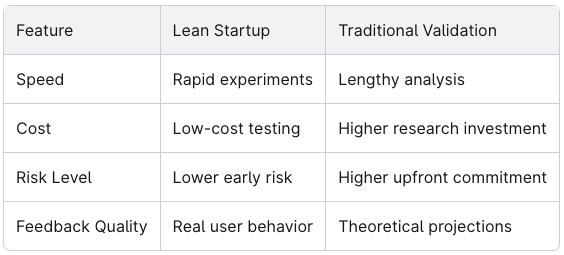
Lean startup validation emphasizes quick learning cycles and real customer feedback, making it ideal for most entrepreneurs with limited resources.

Common Challenges and Solutions
These challenges commonly arise during the validation process for new business ideas.
Challenge 1: Confirmation Bias in Customer Interviews
Solution: Use objective questioning techniques that focus on past behavior rather than future intentions. Ask “How do you currently solve this?” instead of “Would you buy this product?”
Challenge 2: Limited Budget for Market Research
Solution: Leverage free tools like Google Trends for search volume research, social media for customer discovery, and online surveys for broader feedback collection.
Challenge 3: Interpreting Mixed or Negative Feedback
Solution: Look for patterns across multiple data points rather than individual responses. Negative feedback often reveals important insights about customer needs and design thinking opportunities.
Conclusion and Next Steps
Systematic business idea validation significantly improves your chances of building a successful startup by ensuring real market demand exists before major investment. The key is testing assumptions quickly and adapting based on real feedback from your target market.
To get started:
Write down your top 5 assumptions about customers and market demand
Identify 10 potential customers to interview within your target audience
Choose either lean startup or traditional validation based on your resources and timeline
Related Topics: Consider exploring business plan development, product development methodologies, and funding readiness once validation confirms market opportunity.